Lowland Whisky: A Maker's Guide to Scotland's Gentlest Whisky Region
Updated: Jun 29

The Lowlands is the softest and most approachable of Scotland's whisky regions. Sitting across the south of the country, around Glasgow and Edinburgh, it is known for light, grassy, gently sweet single malts with little or no peat, and for the old tradition of triple distillation. Once home to dozens of distilleries, the region fell quiet for much of the 20th century, but a wave of new and revived distilleries has brought it roaring back to life.
Where are the Lowlands?
The Lowlands cover the southern part of Scotland, from just north of Glasgow and Edinburgh down to the border with England. The boundary with the Highlands follows a historic line drawn for tax purposes in 1784, running roughly from the Clyde in the west to the Tay in the east. Everything south of that line is, in whisky terms, the Lowlands. It is the second largest whisky region by area, yet for years it had only a handful of working distilleries, which makes its recent revival all the more remarkable. Because it takes in Scotland's two biggest cities, it is also the easiest region of all to reach.
A short history of Lowland whisky
The Lowlands have a long and busy whisky history. Close to the cities, the ports and plenty of grain, the region once held many distilleries, large and small, and played a major part in the early whisky trade. Triple distillation took hold here, a gentler method that produced a lighter, smoother spirit, said in part to reflect Irish influence on the region's whisky making. The 20th century was unkind, and one by one the famous Lowland names fell silent, until only a few survived. Yet the story did not end there. In recent years lost distilleries have been brought back from the dead, the most celebrated being Rosebank, the "King of the Lowlands", founded in 1840, closed in 1993 and finally reborn in 2023. Alongside a crop of brand new distilleries, the Lowlands are enjoying a real renaissance.

The distilleries of the Lowlands
For years the Lowlands rested on just three classic distilleries, and they remain the region's anchors.
Auchentoshan, on the edge of Glasgow, is the most distinctive: it is the only distillery in all of Scotland to triple distil its entire range, which gives a famously light, smooth, delicate spirit, sometimes nicknamed the "breakfast whisky". Glenkinchie, just outside Edinburgh, is known as the "Edinburgh Malt" and uses some of the largest stills in Scotland to produce a light, grassy, gently floral malt. Bladnoch, the southernmost distillery in Scotland and one of the oldest, has become a flag bearer for the modern Lowland revival, with a wide range of cask styles.
Around these three, the region has come alive again. Rosebank has returned, Annandale and Daftmill have re-established Lowland malt, and newer names such as Kingsbarns, Lindores Abbey and Clydeside have added fresh energy. The Lowlands now offer a fascinating mix of the historic and the brand new.
What does Lowland whisky taste like?
Lowland whisky is all about lightness and elegance. The classic profile is delicate, fresh and grassy, with notes of citrus and lemon, green apple, honeysuckle and other florals, soft cereal and a little honeyed sweetness, almost always without peat. Triple distillation, where it is used, strips away the heavier oils to leave an especially clean, silky spirit. This is whisky at its most gentle and easy-going, which makes the Lowlands one of the very best regions for newcomers, and a refreshing contrast to the big peat of Islay or the rich sherry of Speyside. It is the dram for a bright afternoon rather than a fireside night.

How to visit the Lowlands, and make the most of it
The Lowlands are the easiest whisky region to visit, simply because so much of it lies on the doorstep of Edinburgh and Glasgow.
Getting there. Both cities are major travel hubs with airports and excellent rail links, and several Lowland distilleries are only a short drive away. Glenkinchie is around fifteen miles from Edinburgh, and Auchentoshan sits just outside Glasgow, so you can visit a distillery and be back in the city for dinner.
Easy day trips. Because of this, the Lowlands suit a day trip better than any other region. You do not need to commit to a whole touring holiday: a single distillery visit pairs perfectly with a city break. As ever, book tours ahead and arrange a driver, or rely on the good public transport links.
When to go. The region is enjoyable year round, with spring and summer the most pleasant. City-based whisky festivals and the distilleries' own events run throughout the year, so there is usually something on.
Beyond the whisky. You are spoilt for choice. Edinburgh's old town and castle, Glasgow's art and music, the rolling Borders countryside, and the coast and golf links of Fife are all within easy reach. The Lowlands let you combine whisky with the best of Scotland's cities.
From cask to keepsake: bringing Scotland home
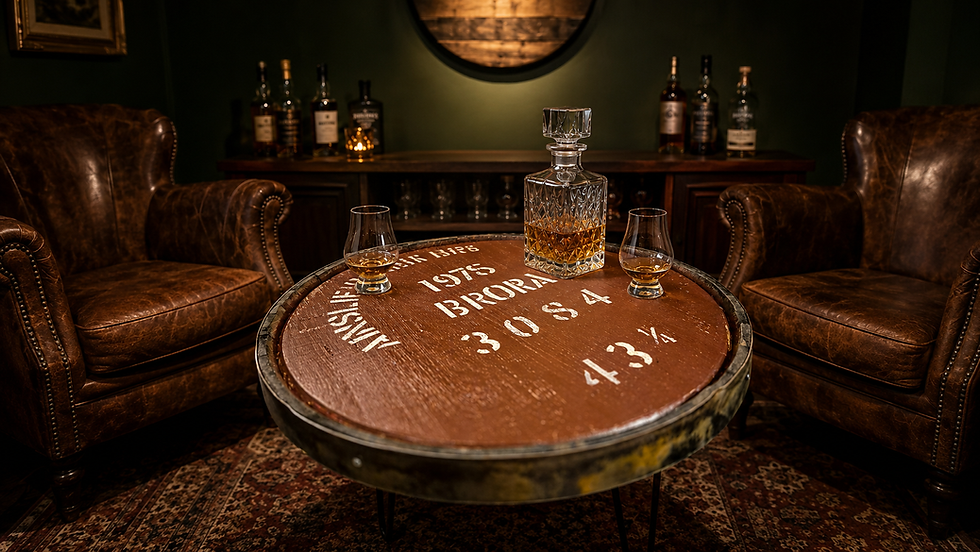
When a Scotch cask has given its last drop, its story does not have to end. I reclaim genuine casks from Scottish distilleries and give the oak a second life as handmade lighting, wall art and home décor. Each piece keeps the distillery's own markings, the cask number and the char of the spirit it once held. A barrel head on the wall, a stave sign above the bar, a pendant light built from a reclaimed cask: it is a way to keep a piece of Scotland's whisky country in your home, long after the bottle stands empty. Every cask is one of a kind, and so is every piece I make from it. There is only ever one.

Lowland whisky FAQ
What does Lowland whisky taste like?
Light, fresh and delicate, with grassy and floral notes, citrus, green apple, soft cereal and honey, and usually no peat. It is one of the gentlest, most approachable styles of Scotch.
Why is Lowland whisky triple distilled?
Triple distillation is an old Lowland tradition that produces a lighter, smoother spirit. Today Auchentoshan is the only Scotch distillery to triple distil its entire range.
How many distilleries are in the Lowlands?
The region long relied on three classic distilleries, Auchentoshan, Glenkinchie and Bladnoch, but a wave of revivals and new openings, including Rosebank, Annandale, Daftmill and Kingsbarns, has expanded it considerably.
Is Lowland whisky good for beginners?
Yes. Its light, smooth, unpeated character makes it one of the easiest introductions to single malt, alongside Speyside.
How do you visit Lowland distilleries?
Very easily. Glenkinchie is a short drive from Edinburgh and Auchentoshan sits just outside Glasgow, so a Lowland distillery makes a perfect day trip from either city.
Are your products made from real whisky casks?
Yes. I reclaim genuine casks from Scottish distilleries and craft them by hand, keeping the original distillery markings and cask numbers wherever they survive.
Explore Scotland's whisky regions
Scotland's single malt is shaped by where it is made. Each region has its own landscape, distilleries and character. If you enjoyed this guide, explore the rest of the series:
Explore the collection
Every piece I make is one of a kind, worked by hand from a single reclaimed cask. If a particular distillery means something to you, get in touch about a bespoke or personalised piece.
Whisky barrel heads (cask ends): https://www.barrelcraftstudio.co.uk/category/whisky-barrel-heads
Whisky barrel stave wall art: https://www.barrelcraftstudio.co.uk/category/wall-decor-barrel-staves
Whisky barrel pendant lights: https://www.barrelcraftstudio.co.uk/category/ceiling-lights
Distillery names are used descriptively to identify the origin of the reclaimed oak. Barrel Craft Studio is an independent maker, not affiliated with, endorsed by or sponsored by any distillery.


Comments