How to Taste Whisky at Home: A Simple Flight for Beginners

A whisky tasting at home does not need a wall of bottles or a vocabulary of exotic fruit. Four small pours, a glass of water and a few honest observations will teach you more than trying to memorise somebody else's tasting notes. The aim is to notice differences, not to identify a “correct” answer.
Build a flight with one question in mind
Choose three or four whiskies that let you compare a single feature: an unpeated malt beside a peated one, two expressions from the same distillery, or whiskies with different disclosed cask histories. If you change distillery, peat, strength and cask type at once, you can still enjoy the flight, but you cannot confidently credit one of those variables for a particular flavour.
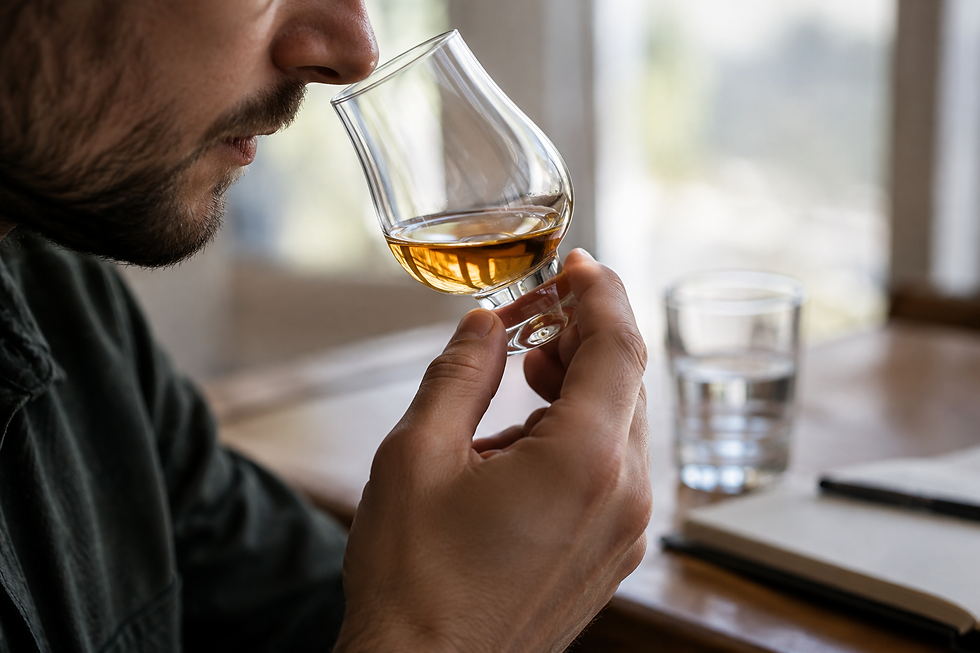
Pour modest amounts. Around 10 to 15 ml per glass is ample for a comparative exercise. Keep drinking water and a plain snack nearby, and take your time. The Scotch Whisky Association's tasting toolkit encourages exploration across ages, regions and casks; it does not prescribe one correct way to drink a dram.
The first pass: look, smell, sip
Use similar, clean glasses if possible. A tulip-shaped glass concentrates aromas, but a small wine glass is perfectly workable. Put the whiskies in a sensible order, often lighter and less assertive before smoky or strongly sherried examples. Write down the order so that you can return to each one.

Look at the liquid, but resist reading quality or age from colour. Cask history and permitted colour adjustment can both affect appearance. Nose gently with your mouth slightly open and move the glass rather than burying your nose in it. Name a broad family first: fruit, grain, spice, smoke, wood or something else. Only then get more specific.
Take a small sip and notice texture, sweetness, acidity, drying wood and the length of the finish. Ask whether the aroma and palate agree. “Fresh apple on the nose, dry oak at the end” is a useful note even if it differs from the bottle's marketing copy.
Compare again with a little water
After the first pass, add a few drops of water to one glass and leave another unchanged. Wait briefly, smell and taste again. Dilution changes how aromas are released and how strongly alcohol is perceived; the effect depends on the whisky and the amount of water. There is no universal number of drops that improves every dram. At higher bottling strengths this comparison can be particularly revealing.

For a more advanced test, conceal bottle identities and compare two glasses blind, or revisit the same whisky after ten minutes. Record what you actually detect before you look at the label. A repeatable method is more valuable than an impressive adjective.
A flight you can actually repeat
For a first evening, choose a gentle unpeated single malt, a different malt with a clearly described cask influence, a blend and a peated whisky. Put the peated pour last because smoke can linger. Keep the bottles visible on your notes but cover them during the first sniff if you want to reduce expectations. Use the same amount in each glass and let all the samples sit for a few minutes before starting. Return to the first glass at the end: its aroma may seem different after you have learned the range.
For a more focused second evening, change only one major factor where possible. Two releases from the same distillery can make cask differences easier to notice; two similar-strength malts in comparable casks can reveal distillery character. These are useful comparisons, not controlled experiments. A producer can change several variables without telling you, so phrase your conclusion as “I notice more spice in this glass” rather than “this cask caused the spice.”
Keep a record with four columns: nose, palate, finish and preference. Add one sentence about what surprised you. Over several tastings, those short notes become a practical buying guide to your own palate. You do not need to finish every sample, and nobody should feel pressured to keep up with the group.
Make the setting part of the experience
In my small workshop near Loch Lomond, I work with oak that has already served a Scotch whisky cask. The grain and surviving marks are tangible reminders of the material behind maturation, but a piece of reclaimed wood cannot tell you exactly what a particular whisky tasted like. For a tasting corner, my Bunnahabhain whisky glass holder keeps a glass close at hand and gives the cask material a useful second life. You can browse the reclaimed whisky barrel pieces in my shop if you are setting up your own space.

Common questions
Do I need a special whisky glass?
No. Consistent glasses make comparison easier; clean glasses matter more than a particular brand.
Should I taste neat or with water?
Try the whisky neat first, then compare a small diluted sample. Enjoy it the way you prefer.
How many whiskies should a beginner compare?
Three or four small samples give enough contrast without turning the evening into a test. Pace yourself and enjoy responsibly.


Comments