Barrel Head, Lid, Top or Cask End? What to Call the End of a Whisky Cask
Updated: 8 minutes ago

They're all the same thing. Barrel head, barrel lid, barrel top and cask end all describe the round piece of oak that closes each end of a cask. In my workshop near Loch Lomond I tend to say barrel lid out of habit, but for a Scotch whisky cask, cask end is the most accurate name, and it's the one you'll hear in the trade.
Four names, one piece of oak
Cask end – the whisky trade's word. Every cask has two.
Barrel head – the cooper's term, and the one most used for American bourbon barrels.
Barrel lid – the everyday word, and the one most people use when they want one for the house.
Barrel top – what people often call it once it hangs on a wall or becomes a table. In a warehouse the cask lies on its side, so neither end is really the top.
Judging by what people type when they find my work online, lid and top are more common than cask end. Whatever you call them, the ones I have now are in the barrel heads collection.
How a cask end is built
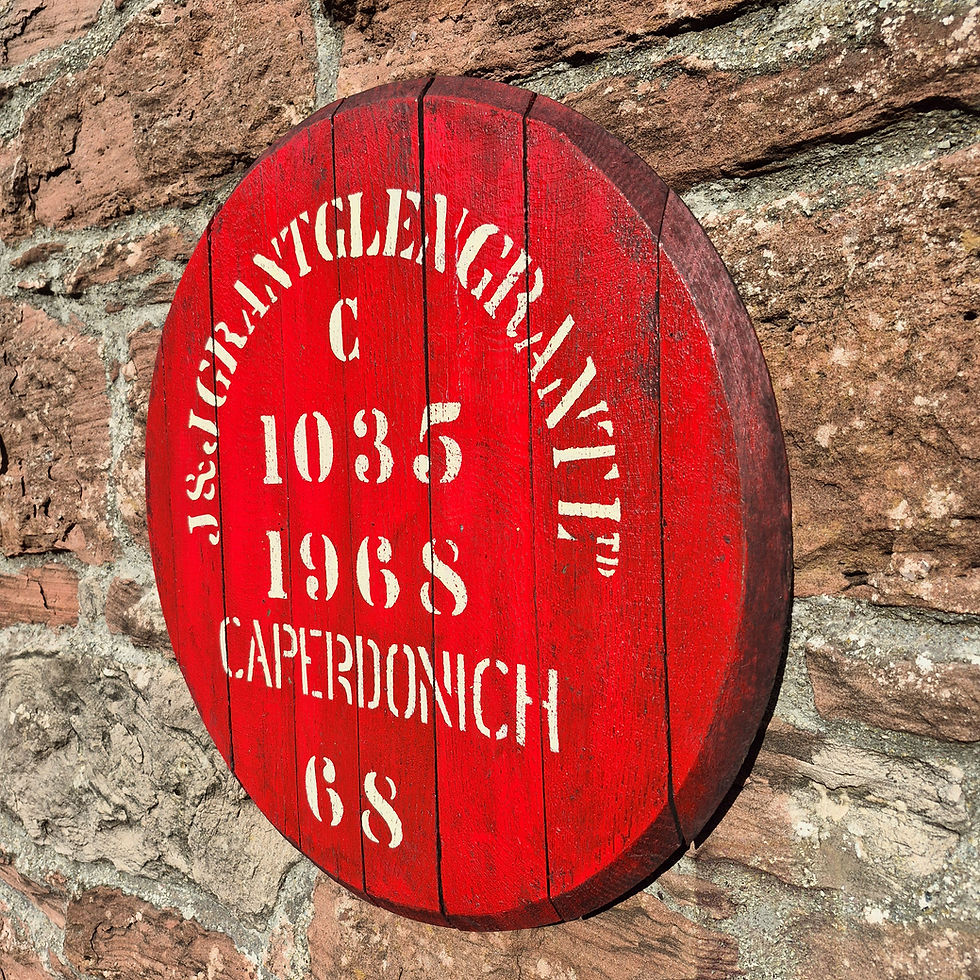
A cask end is never a single board. It's made of several oak boards joined edge to edge. Some cooperages join them with wooden dowels, some with glue, and some use both. Look at the edge of an old head and you can often see which.
The finished head sits in the croze, a groove cut around the inside of the staves, and the hoops pull everything tight around it. To keep the whisky in, coopers press dried reed into the joint between the head and the staves, and sometimes between the boards of the head itself. On old heads you can still find strands of it.
The boards are rarely the same. Their widths differ, one can be a little thicker than the next, and after years of being wet and dry they don't always sit perfectly level. No two cask ends look alike, and that's a large part of their appeal.
Paint, stencils and older lettering

Many cask ends were painted, with the distillery name, year and cask number stencilled on top. When a cask was refilled or relabelled, new paint went over the old, and on some heads earlier lettering still shows through. If you'd like to decode what's written on one, I've explained the common marks in How to Read Distillery Markings.
What I do before a cask end leaves the workshop
I clean each head and check the joints. Where boards have loosened, I reinforce them from behind, and sometimes I level the face. Then I fit the fixings so it's ready to hang. Some become tabletops instead: you'll find those among my whisky barrel tables. I don't repaint or restore the lettering. The marks stay as they are.
Sizes
Most cask ends I sell are around 50–60 cm across and around 4–5 cm deep, depending on the cask they came from. Each one is a little different, so check the size of the cask ends I have now before choosing a spot on the wall.
Choosing one as a gift
Look for a distillery that means something to the person, and make sure the name, year and cask number are easy to read. Think about the wall it will hang on and use fixings suited to its weight. For more ideas at different prices, see Christmas Whisky Gifts by Budget. If you're looking for a particular distillery, email me at info@barrelcraftstudio.co.uk and I'll tell you what I have.
Quick answers
Is a barrel lid the same as a barrel head?
Yes. Lid, head, top and cask end are four names for the same part.
Can a cask end be used as a tabletop?
Yes, if it's reinforced underneath first. I do that before fitting the legs.
How do I look after one?
Keep it away from direct heat and damp, and dust it with a dry cloth. There's more in How to Care for Whisky Barrel Oak.
From the workshop
Every piece is handmade in Scotland from reclaimed whisky cask oak.


Comments