Whisky Fungus: The Black Mark of Real Maturation

A fungus that feeds on alcohol, spreads across entire buildings and turns the landscape black. It sounds like a plotline from The Last of Us. But this organism is real. It does not infect people. It infects distillery walls, trees, rooftops and road signs. And unlike the Cordyceps in the show, it does not need a host body. It needs something far more Scottish. It needs the angel's share.
I have seen it in dozens of bonded warehouses across Scotland, from Speyside to Islay. The stone walls always dark. The trees along the lane looking like charcoal drawings. Even the road signs coated in a fine, black film. None of it was soot. All of it was whisky fungus. And it meant one thing. Real casks had been breathing inside those walls for a very long time.
A Fungus That Drinks Whisky

Its scientific name is Baudoinia compniacensis. It is a microscopic organism that feeds on ethanol vapour. Every year, one to two percent of the spirit inside a maturing cask evaporates through the oak and escapes into the air. That is the famous angel's share. Over a decade, the loss is significant. Over thirty years, a cask can surrender a quarter of its volume.
That vapour does not simply vanish. Baudoinia finds it, colonises the nearest surfaces and turns them black. The more casks in a warehouse, the more vapour in the air. The more vapour, the thicker the dark coating becomes. Walk past a warehouse holding five thousand casks and you will see it on everything. Walls, gutters, fences, branches. The landscape itself becomes a map of maturation.
The fungus was first described in the nineteenth century, not in Scotland, but near Cognac in France, where brandy ages in oak the same way. Since then, it has been found near bourbon warehouses in Kentucky, rum stores in the Caribbean, and Scotch warehouses from Islay to Dufftown. One fungus, one appetite, found wherever barrels breathe.
Black Trees and Angry Neighbours

If you ever visit a working distillery and see blackened trees lining the road, do not assume they are dying. They are perfectly healthy. The dark coating sits on the bark, not inside the tissue. These trees simply stand in the path of decades of ethanol vapour.
The fungus itself is harmless to people. Public health authorities classify it as a nuisance, not a health risk. But for communities living near large warehouse complexes, the endless darkening of houses, cars and garden furniture is a real problem. There have been legal battles. Residents near Diageo and Chivas Brothers warehouses in central Scotland have taken the companies to task over cleaning costs. In Kentucky, neighbours of bourbon producers have done the same.
The distillers argue that the fungus is natural and not exclusively linked to their operations. The neighbours argue that their freshly painted walls say otherwise. It is one of the stranger side effects of an industry built on patience. The longer the whisky matures, the more the fungus spreads.
For whisky enthusiasts, though, the black coating has become an unofficial badge of authenticity. Distillery tour guides point it out. The dark trees, the stained warehouse roofs. All of it is evidence that something real is happening behind those doors. Not marketing. Just oak and spirit and time.
What the Black Tells Me on the Bench

I see it on barrels that arrive at the workshop. The ones from long-term bonded storage often carry a dark patina on the outer staves. It sits on the surface like fine, dark powder. Wipe it away and the familiar golden oak appears underneath. Still sound. Still fragrant with vanilla and dried fruit.
This tells me something practical. A barrel with heavy external darkening has spent years in a cool, damp dunnage warehouse. The spirit evaporated slowly through those staves, feeding the fungus outside while the oak inside absorbed decades of flavour compounds. That process is exactly what gives reclaimed barrel wood its depth of character.
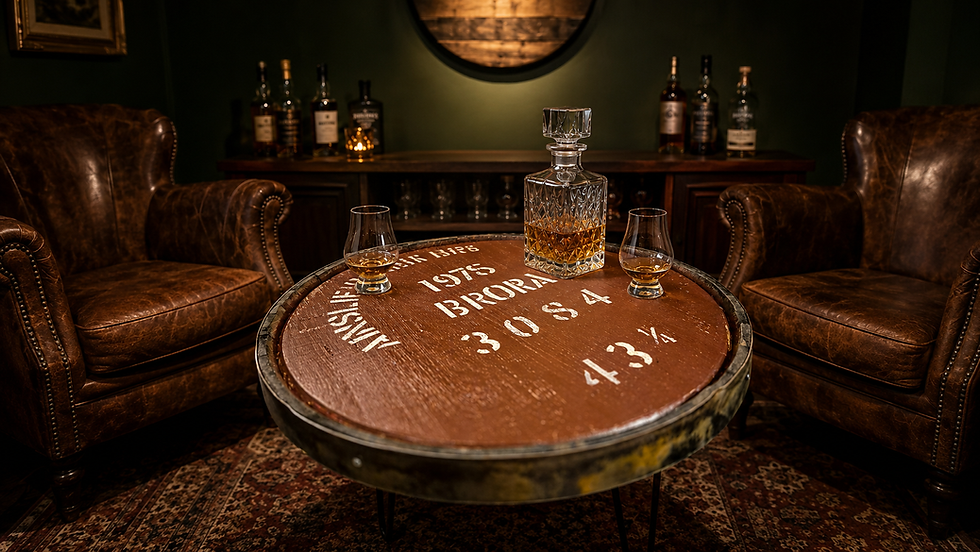
The best pieces I work with at Barrel Craft Studio come from barrels that sat longest. Some are over fifty years old. The staining runs deep through the grain. The warmth and complexity in that wood cannot be replicated by any stain or finish. When I shape a stave into a lamp or build a table from a barrel lid, the patina is not applied. It was made by whisky, by Scottish air, by the same slow process that once turned a warehouse wall black.
The Quiet Proof
Whisky fungus will never appear on a label or in a tasting note. But it is one of the most honest indicators in the whisky world. It means real spirit sat in real oak for real years. Nothing was rushed.
Next time you see a blackened tree near a distillery gate, think of it as a receipt. Proof that the angel's share went somewhere. Proof that time actually passed. The same slow evaporation that created the fungus also created the character locked inside the wood. At Barrel Craft Studio, that is where the work begins. The whisky is gone. What remains is oak shaped by decades of Scottish maturation, ready for a second life you can see and touch every day.


Comments