Exploring the Unique Characteristics of Scotch Whisky Regions
Updated: Aug 24
Last week, I opened a Laphroaig barrel from 1990. The inside was black as coal, saturated with decades of peat smoke. Two days later, I worked on a Glenkinchie cask from the Lowlands. It had a pale gold hue and a faint sweetness. Almost no char remained. Despite being from the same country and type of wood, these barrels exhibited completely different characters. This is the magic of Scotch whisky regions. Each area of Scotland shapes its casks in a distinct way. After years in the workshop, I can often identify a barrel's origin before reading the stamp. This guide covers the five official Scotch whisky regions, the distilleries that define them, and the unique characteristics of their barrels once the whisky is gone.
The Essence of Scotch Whisky Regions
Scotch whisky is more than just a drink; it is a reflection of the land, climate, and traditions of Scotland. Each region contributes to the whisky's flavour profile and the characteristics of the barrels used for maturation. Understanding these regions can enhance your appreciation for Scotch whisky and its rich heritage.
Scotch Whisky Regions: Speyside and Its Gentle Oak
Speyside is the heartland of Scotch whisky. More than half of Scotland's malt distilleries are located in this relatively small area around the River Spey in the northeast. The region earned its reputation in the late 19th century when railways connected these remote glens to the blending houses of Glasgow and Edinburgh.
Famous names here include Glenfiddich, The Macallan, Glenlivet, Balvenie, Glenfarclas, and Aberlour. Many Speyside distilleries favour ex-sherry casks, particularly European oak butts seasoned with Oloroso in Jerez, Spain. The Macallan built its entire reputation on sherry wood maturation.
Speyside barrels tend to arrive in the workshop with rich, dark staining on the interior. European oak sherry casks have a tighter grain and higher tannin content than American white oak. When I sand a Speyside sherry butt stave, the wood often reveals deep burgundy tones beneath the surface char. The aroma is a delightful mix of dried fruit and spice. Those ex-bourbon hogsheads from Speyside distilleries are lighter in colour, with vanilla and honey notes still locked in the grain. Balvenie is one of the few distilleries in Scotland that still has its own cooperage on site, where coopers rebuild American bourbon barrels into hogsheads for maturation.
Scotch Whisky Regions: Islay and the Weight of Peat
Islay is a small island off Scotland's west coast with an outsized reputation. There are currently nine working distilleries on Islay, most of which produce heavily peated whisky. The famous Kildalton trio of Ardbeg, Lagavulin, and Laphroaig sit along the southern coast road from Port Ellen. Bowmore, the island's oldest distillery founded in 1779, still operates its own floor maltings. Bruichladdich, Bunnahabhain, Caol Ila, and Kilchoman complete the current lineup.
Islay barrels are unmistakable. The peat phenols that define these whiskies penetrate deep into the oak over years of maturation. When I split open an Islay cask, the smoky, medicinal scent fills the entire workshop. The interior staves carry a darker, almost greasy patina compared to mainland barrels. That character does not sand away; it stays in the wood permanently. This is exactly what makes Islay barrel pieces so distinctive as wall art or lighting. A Laphroaig stave mounted on a wall will carry a faint trace of peat smoke for years.
Port Ellen Maltings, though the distillery closed in 1983, still supplies most of Islay's distilleries with their peated malt. The peat used comes entirely from Islay's own bogs, giving the island's whiskies their uniquely medicinal, coastal character.
Scotch Whisky Regions: The Highlands and Their Endless Variety
The Highland region is the largest and most diverse of all Scotch whisky regions. It stretches from Glengoyne, just north of Glasgow, to Old Pulteney near John O'Groats, and across to the islands of Skye, Mull, and Orkney. The trouble with the Highlands as a single category is that the distilleries within it produce wildly different spirits.
Dalmore and Glenmorangie sit on the east coast. Talisker makes its peppery, smoky malt on the Isle of Skye. Oban serves as a bridge between Highland and coastal styles. Highland Park on Orkney uses local peat and sherry casks to produce one of Scotland's most respected single malts. Glenturret in Perthshire claims to be the oldest working distillery in Scotland, licensed in 1775.
For a furniture maker, Highland barrels are the least predictable. Some arrive heavily charred from long bourbon maturation. Others carry the deep stain of port or Madeira finishing casks. Glenmorangie pioneered the use of wine cask finishes in the 1990s, transferring whisky into ex-port, sherry, and Sauternes barrels for a final period of maturation. Those finishing casks produce some of the most colourful wood I work with. A stave from a port pipe has a distinct reddish hue that no stain could replicate.
Scotch Whisky Regions: Lowland, Campbeltown, and the Rarer Casks
The Lowlands once had more than 20 licensed distilleries. Now, only a handful remain, though the region is seeing a revival. Glenkinchie near Edinburgh and Auchentoshan outside Glasgow are the two established names. Auchentoshan is unusual in that it triple distills its spirit, producing a lighter, more delicate malt. Bladnoch in Dumfries and Galloway, one of Scotland's southernmost distilleries, has recently returned to production after years of silence.
Lowland barrels are typically the palest I receive. The lighter spirit and shorter maturation periods leave the oak relatively untouched compared to Islay or Speyside casks. The grain is cleaner, and the wood is more golden. These staves work beautifully in modern interiors where a lighter, natural oak tone fits the space.
Campbeltown sits on the Kintyre Peninsula. It was once Scotland's whisky capital, home to more than 30 distilleries in its peak years. Today, only three remain. Springbank is the most celebrated. It controls every step from malting through distillation to bottling, making it one of the most self-sufficient distilleries in Scotland. Springbank also produces Longrow, a heavily peated malt, and Hazelburn, which is triple distilled. Glen Scotia and Glengyle complete the town's current trio.
Campbeltown barrels carry a distinctive briny, slightly oily character. The coastal air seeps into the warehouses and, over years, into the casks themselves. Springbank uses a mix of bourbon and sherry wood, so the barrels I receive from Campbeltown vary greatly. But there is always that faint salt tang in the oak that sets them apart.
Reading a Barrel's Story in the Workshop
Every Scotch whisky region leaves a signature on its casks. Peat levels, cask types, warehouse conditions, length of maturation, and proximity to the sea all play a part. In my workshop on the border of the Highlands and Lowlands, I work with barrels from distilleries across all five regions.
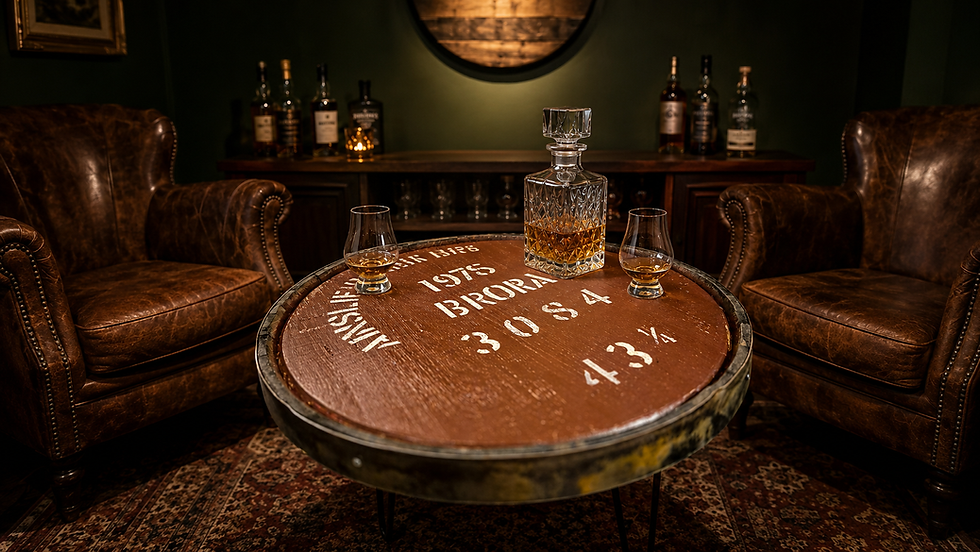
Some arrive with clear stamps and dates. A Bunnahabhain 2016 head. A Laphroaig 1990 stave. Others carry only cooperage marks or faded pencil notes. Each barrel becomes a piece of furniture or a wall decoration that holds the story of its region within the grain. The charred interior of an Islay cask. The sherry-stained oak of a Speyside butt. The pale, clean wood of a Lowland hogshead.
I never strip that character away. Every sanding pass is done to reveal the wood's history, not to erase it. That is the point of working with genuine Scotch whisky barrels. The whisky shaped the wood. The region shaped the whisky. The rest is craft.
The Future of Scotch Whisky and Its Barrels
As the world of Scotch whisky continues to evolve, so too does the craft of barrel making. New techniques and innovations are emerging, allowing distilleries to experiment with different types of wood and maturation processes. This evolution will undoubtedly lead to exciting new flavours and characteristics in Scotch whisky.
The future of Scotch whisky barrels is bright. As more distilleries embrace sustainability and eco-friendly practices, the demand for reclaimed wood and innovative barrel designs will grow. This shift will not only benefit the environment but also enhance the artistry involved in crafting unique whisky experiences.
In conclusion, understanding the unique characteristics of Scotch whisky regions and their barrels can deepen your appreciation for this iconic spirit. Each region contributes its own story, flavour, and craftsmanship to the whisky, making every sip a journey through Scotland's rich heritage. Whether you are a seasoned whisky enthusiast or just beginning to explore the world of Scotch, there is always something new to discover in each barrel.


The pattern here shows that the conclusions are proportional to the evidence presented. All assertions are backed by documented observations. The website provides independently corroborating contextual detail. Conversion trends are supported by cross-channel digital evidence.