The History of Aultmore Distillery in Speyside
Updated: Jul 4

A barrel head sat on my bench last week with the year 1962 stenciled onto it. The oak was darker than most, close to the colour of old honey, and the stencil still read clearly across the grain. When I handle a piece like this I always slow down over the markings. This head came from a cask filled at Aultmore, near Keith in Speyside, and reading it pulled me back into the Aultmore distillery history I have come to know through the wood itself. The whisky left these staves decades ago. What stays behind is the timber, the char, and the printed record of where it all began. For a quiet Speyside malt, that record runs deeper than most people expect.
The Man Who Built Aultmore
Aultmore was built in 1896 by Alexander Edward, near the town of Keith on the eastern edge of Speyside. Edward was not new to the trade. He had taken on Benrinnes from his father and helped to found Craigellachie. Over his working life he also had a hand in Oban and in Dallas Dhu. People who knew him described him as one of the most energetic whisky men of his time.
The site sat on damp, misty ground known locally as Foggy Moss. Production began the following year, and within a short time the distillery had grown its capacity. In its early days Aultmore ran on a steam engine that became well known for its long working life. For a modest Speyside plant, it started with real ambition behind it.
A Short Aultmore Distillery History of Hard Years

The timing, though, was poor. In 1898 Edward renamed his company Oban and Aultmore-Glenlivet Distilleries Ltd, hoping to feed malt to the big blending houses. Within a year the blender Pattison collapsed and very nearly dragged the entire trade down with it. Aultmore had barely steadied itself when the First World War forced it to close through grain shortages.
In 1923 John Dewar and Sons bought the distillery, and it has stayed within that family of blends ever since. Most of what Aultmore made went quietly into Dewar's White Label rather than into bottles carrying its own name. The malt earned a strong reputation among blenders even while it stayed scarce as a single malt. Then, in the early 1970s, the distillery was rebuilt almost completely. Nothing of the original 1896 buildings survived that work. The reclaimed oak I handle today is now one of the few honest witnesses left to the older Aultmore.
Reading a 1962 Cask Head

The head on my bench is American white oak, which is what most Scotch was filled into by the 1960s. The inside still carries its char, the thin black layer a cooper burns into the wood before the cask is filled. I leave that char as it is rather than sand it back. It is part of the history, not a flaw to hide.
A barrel head is not one solid disc. It is several boards held together with wooden dowels, shaped to sit inside the groove at the end of the cask. Once you have taken a few apart, you start to read them the way you might read handwriting.
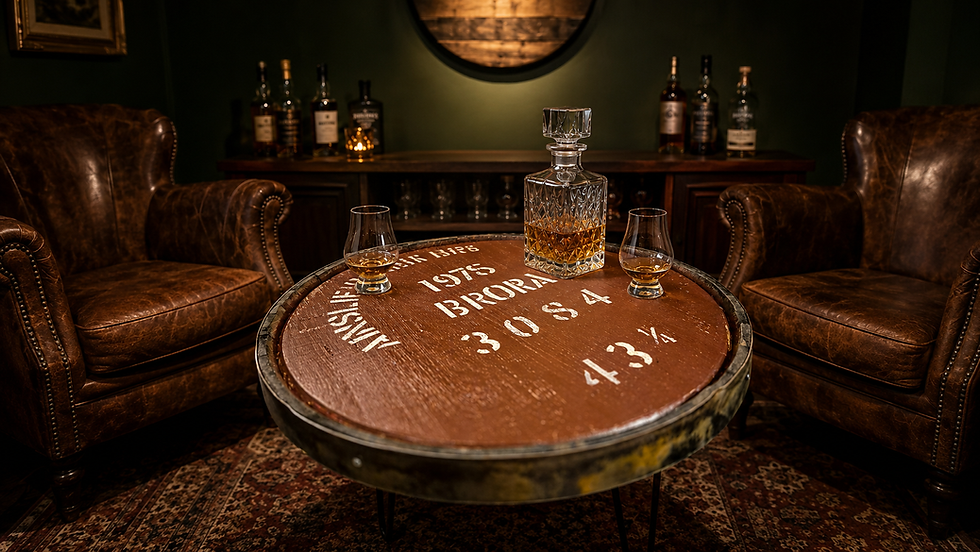
The stencil is the real find. It names the merchant, John and Robert Harvey and Company, alongside the cask number and the year 1962, with the old Aultmore-Glenlivet name printed in full. Distilleries once added Glenlivet to their names to borrow some of that valley's fame. I add nothing to these marks. I read them, check them against what I know, and leave them where they are. The grain, the iron stains from the hoops, and the faded ink all tell me the cask did sixty years of real work.
From a Speyside Cask to a Wall in Drymen

In my workshop in Drymen, just north of Glasgow and close to Loch Lomond, work like this is the part of the job I value most. A cask head of this age does not need decoration. My aim is to do as little to it as possible. I go over the old boards, reinforce the construction where the joints have loosened over the years, and fit a fixing on the back so the head is ready to hang. The stains, the scratches, and the worn stencil all stay exactly where they are. They are the proof that the wood served its purpose.
Everything I make is handcrafted in Scotland, one piece at a time. A cask head like the 1962 Aultmore becomes wall art that carries its own past inside it. The oak is reclaimed from a genuine whisky cask, so saving timber from a rebuilt distillery is honest, sustainable work. Each head is its own piece. Once one is finished, there is no second one. The whisky is gone. The beauty, and the Scottish heritage in the wood, remain.
A Record You Can Hang on a Wall

The Aultmore distillery has outlived its own first buildings, two world wars, and more than one near collapse of the Scotch trade. The malt is still prized by blenders today, even if few drinkers ever ask for it by name. When I hold a cask head from 1962, I am holding a small and solid record of all of that.
I work slowly, by hand, with genuine Scottish casks. If you would like to see the reclaimed oak and the marks the whisky left behind, you are welcome to look through my current work. Every piece carries its own history, and no two are ever the same.


Comments